
How to Use Moringa Powder...
April 28, 2026
Your cart is empty
Start Shopping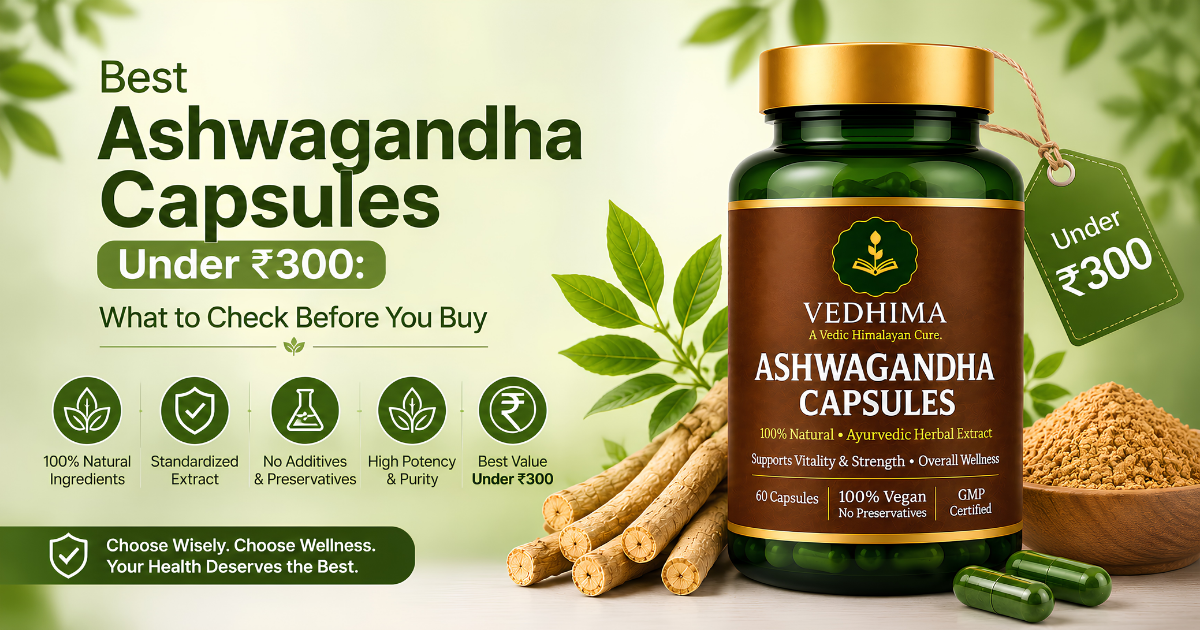
Open any marketplace and you will find Ashwagandha Capsules at ₹149, ₹283, ₹699 and ₹1,400 — all showing "500mg" on the label, all showing sixty capsules in the bottle.
Same herb. Same milligrams. Same count. Nine times the price.
Something in that equation is not being explained, and it is almost never the marketing. The difference sits in details most brands leave off the label entirely — and once you know what those details are, choosing between Ashwagandha Capsules in India stops being a guessing game.
This guide walks through the eight things worth checking before you spend anything, and shows you how to work out what you are actually paying per day.
Why Price Alone Tells You Nothing
Ashwagandha (Withania somnifera) has been used in Ayurveda for centuries. That part is not in dispute. What varies enormously is what ends up inside the capsule.
The ₹150 Problem
A bottle of 60 capsules at ₹149 works out to roughly ₹2.50 per capsule — including the bottle, the label, the shell, GST, shipping and the seller's margin.
Once you subtract all of that, very little is left for the herb itself. At that price point, what you are almost always buying is milled root powder pressed into a shell. It is genuine ashwagandha. It is simply the least concentrated form of it.
What Actually Changes Between Price Tiers
|
Price Band |
What You Typically Get |
|
Under ₹200 |
Milled root powder, often with fillers, no potency disclosure |
|
₹250–₹400 |
Standardised root extract, veg shell, licensed manufacturer |
|
₹600–₹1,500 |
Branded patented extracts with published clinical trial data |
The sweet spot for most buyers sits in the middle band. You get a genuine extract without paying the premium that branded extract licensing adds to the shelf price.
8 Things to Check Before You Buy Ashwagandha Capsules
1. Extract or Powder?
This is the single most important distinction, and the one most brands avoid making clear.
Root powder is dried ashwagandha root, milled fine and encapsulated. Root extract concentrates the active compounds, meaning a smaller quantity delivers considerably more.
If the label says only "Ashwagandha 500mg" with no mention of extraction, assume powder. Brands that have invested in an extract say so, because it is the thing they are charging for.
2. The Withanolide Percentage
Withanolides are the compounds researchers study when they study ashwagandha. Their concentration is what separates one capsule from another.
Two capsules can both say 500mg and contain wildly different amounts of active compound depending on whether the contents are raw powder or a standardised extract. A brand that publishes its withanolide percentage is showing you something it can be held to. A brand that does not may simply have nothing worth showing.
Look for the percentage. If it is absent from the label, the product page and the FAQ, ask before you buy.
3. Root Only, or Root and Leaf?
Classical Ayurvedic texts specify the root of Withania somnifera. Some modern manufacturers include leaf material, which is cheaper to source and changes the compound profile.
Neither is inherently wrong, but they are not interchangeable. If a brand does not specify the plant part, that is a gap worth noticing.
4. Milligrams Per Capsule and Capsule Count
You cannot compare prices without both numbers. A ₹283 bottle of 60 capsules and a ₹283 bottle of 30 capsules are not the same purchase, and product pages that hide the count are relying on you not checking.
This applies to milligrams too. "Net weight 250g" on a listing usually refers to packed shipping weight, not dose. Find the per-capsule figure.
5. The Capsule Shell — Veg or Gelatin
Most people never think about the shell, and in India it matters a great deal.
Gelatin capsules are typically derived from bovine or porcine sources. For vegetarian, Jain and many other buyers, that is an absolute dealbreaker — and it is rarely stated prominently.
Vegetarian capsules use HPMC, a plant-derived cellulose. If a brand has gone to the expense of using veg shells, it will usually say so. Silence generally means gelatin.
6. Fillers and Bulking Agents
Check the full ingredient list, not just the headline. Excipients like magnesium stearate, silicon dioxide or maltodextrin are common in manufacturing, but a long filler list on a short ingredient panel tells you where the cost has been saved.
The cleanest labels list the herb, the shell, and very little else.
7. Manufacturer Details and Licensing
A marketplace seller name is not a manufacturer. Look for the actual manufacturing unit, its address, and its licensing — AYUSH licence for Ayurvedic products, GMP certification for manufacturing standards, FSSAI where applicable.
This information is legally required on packaging in India. If it is missing from the online listing, ask for it before ordering.
8. Independent Testing and Medical Review
Herbal supplements sit in a category where contamination testing genuinely matters. Heavy metal screening, microbial testing and batch traceability are the marks of a manufacturer running a proper quality system.
Separately, check whether the health content on the site has been reviewed by a qualified practitioner. A named BAMS or medical reviewer with a review date signals a brand willing to put its claims in front of someone qualified to challenge them.
How to Calculate the Real Cost Per Day
This one calculation cuts through most marketing.
Formula: Price ÷ Capsule Count × Daily Dose = Cost Per Day
Take Ashwagandha Capsules priced at ₹283 for 60 capsules, taken twice daily:
₹283 ÷ 60 = ₹4.72 per capsule ₹4.72 × 2 = ₹9.44 per day
Now run the same maths on a ₹149 bottle of 30 capsules at the same dose: ₹4.97 per capsule, or ₹9.93 per day — more expensive daily, despite the lower shelf price, and likely powder rather than extract.
The cheaper bottle is frequently the costlier routine. Run this calculation before every purchase.
Red Flags Worth Walking Away From
That last one is more telling than it sounds. A brand confident in its sourcing writes Withania somnifera root extract. A brand that is not writes "ashwagandha."
Why Vedhima Herbal Ashwagandha Capsules Fit This Checklist
Our Ashwagandha Capsules are priced at ₹283 and built around exactly the criteria above.
We would rather publish the details and let you compare than ask you to trust a claim. If you are weighing Ashwagandha Capsules in India at this price point, run our page through the eight checks above — and run every competitor through the same list.
You can browse the complete range on our Herbal Vegan Capsules page.
Who Should Speak to a Practitioner First
Ashwagandha is generally well tolerated, but a few groups should consult a qualified practitioner before starting:
This article is educational and is not a substitute for personalised medical advice.
Make an Informed Choice
The best Ashwagandha Capsules under ₹300 are not necessarily the cheapest on the page — they are the ones willing to tell you what is inside them.
Check the extract type. Check the withanolide percentage. Check the capsule count and do the daily-cost maths. Any brand that makes those four things hard to find has already answered your question.
Explore Vedhima Herbal Ashwagandha Capsules — root extract, vegetarian shells, licensed manufacturing, and every detail published where you can check it.
Medically reviewed by Dr. S. Saini, BAMS — Ayurvedic Wellness Consultant. This content is for educational purposes only and does not constitute medical advice.
April 28, 2026
August 31, 2026
May 01, 2026